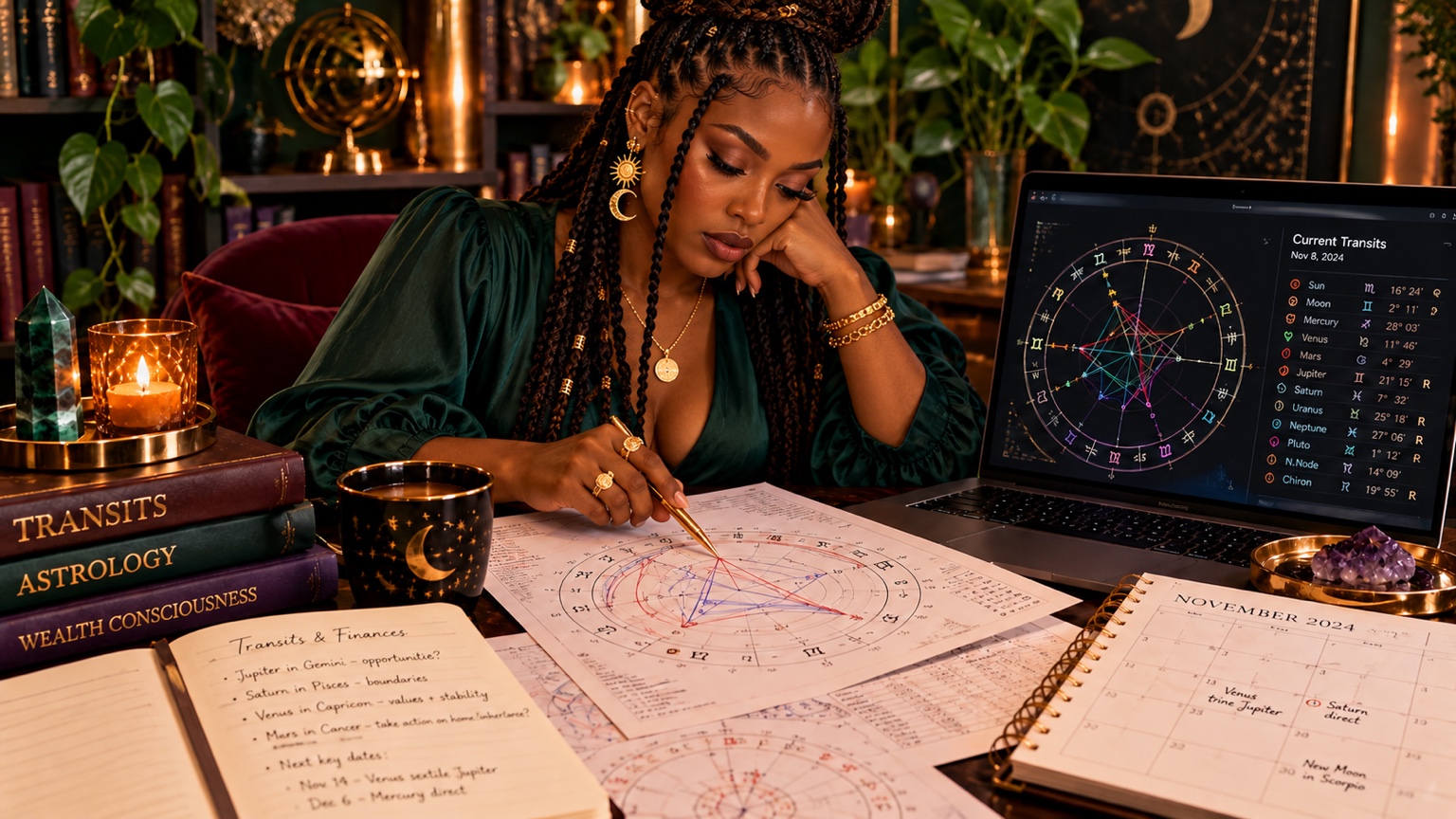
A Western Astrology and Kemetic Inspired Reflection on Money, Value, and Stewardship
At EnrichedMindsets, financial astrology is not about predicting a guaranteed fortune. It is a reflective language for exploring values, habits, resources, responsibility, and the meaning we attach to wealth. A natal chart can offer questions to consider, but it does not replace financial education, sound judgment, or practical planning.
This article brings modern Western astrology into conversation with ancient Egyptian sky traditions and Kemetic inspired symbolism. The distinction matters. Ancient Egypt had sophisticated astronomy, calendars, star clocks, planetary observations, and decans. The familiar twelve sign zodiac became part of Egyptian celestial culture much later through Greek and Babylonian influence. For that reason, the Kemetic connections below are presented as respectful modern symbolic parallels, not as claims that ancient Egyptians used the same planetary system found in modern natal astrology.
Before We Merge the Traditions: Honor the History
Ancient Egyptian observers carefully watched the sky. The Metropolitan Museum of Art describes the astronomical ceiling from the tomb of Senenmut, dating to the reign of Hatshepsut and Thutmose III, as showing constellations, protective deities, planets, and stars known as decans. The decans helped track the hours of the night and were woven into Egyptian timekeeping and religious life.
That tradition is not identical to the modern Western zodiac. Later Egyptian monuments, including material from the Greco Roman period, show a blending of older Egyptian celestial traditions with zodiacal ideas that developed through wider Mediterranean exchange. This history gives us a richer way to work today: not by collapsing different traditions into one, but by allowing them to speak beside one another.
Venus: Value, Receiving, and Relationship
Within modern Western astrology, Venus is commonly associated with value, pleasure, attraction, relationships, beauty, and the way we receive. In financial reflection, Venus can invite questions about what you value, what you believe you deserve, what you are willing to receive, and how pleasure influences spending and earning.
A strong Venus signature does not guarantee money. It may simply make themes of value, beauty, connection, comfort, or creativity more visible in a person's financial life.
A Kemetic Inspired Reflection: Het Heru
Het Heru, often known by the Greek name Hathor, carries themes of joy, beauty, music, love, celebration, and generative life. In a modern Kemetic inspired financial practice, Het Heru can serve as a symbolic mirror for receiving, enjoyment, creativity, and the question of whether prosperity is allowed to include joy. This is a contemporary interpretive parallel rather than an ancient one to one equation between Het Heru and the planet Venus.
Jupiter: Expansion, Opportunity, and Meaning
Jupiter is traditionally associated in Western astrology with expansion, belief, wisdom, opportunity, generosity, and growth. Financially, Jupiter can point us toward the places where we seek more: more knowledge, more reach, more confidence, more experience, or more possibility.
Jupiter also offers a useful caution. Expansion without discernment can become excess. In practical money work, the Jupiter question is not only “Where can I grow?” It is also “What can I responsibly sustain?”
A Kemetic Inspired Reflection: Amun
Amun carries associations with hiddenness, sacred power, and divine presence. Modern spiritual practitioners may use Amun symbolically when reflecting on unseen potential, faith, and what is developing before it becomes visible. This can be a meaningful companion to Jupiter themes, but it should be understood as a modern interpretive bridge rather than a historically established planetary correspondence.
Saturn: Structure, Boundaries, and Stewardship
Saturn is associated with time, responsibility, limitation, maturity, discipline, boundaries, and long term building. Of all the traditional planets, Saturn may offer some of the most practical financial symbolism.
Budgets, debt repayment, insurance, estate preparation, savings habits, recordkeeping, and patient accumulation all live comfortably within Saturn's symbolic language. Saturn reminds us that abundance is not only about attracting resources. It is also about protecting, organizing, and sustaining what we have.
A Kemetic Inspired Reflection: Geb
Geb is connected with the earth and the grounded physical realm. In a modern integrative practice, Geb can symbolize material foundation, embodiment, land, resources, and the wisdom of building from solid ground. The parallel with Saturn is symbolic and contemporary, not a claim of an ancient planetary equivalence.
Pluto: Transformation, Power, and Financial Rebirth
Modern astrology often connects Pluto with transformation, power, endings, rebirth, hidden dynamics, and deep psychological change. Pluto can be useful when reflecting on major financial transitions, inherited money patterns, control, debt, shared resources, and the need to rebuild after disruption.
Historically, however, Pluto cannot be part of an ancient Egyptian planetary system. Pluto was discovered in 1930. Any connection between Pluto and an Egyptian deity is therefore a modern symbolic association.
A Kemetic Inspired Reflection: Asar
Asar, commonly known as Osiris, carries powerful themes of death, renewal, continuity, order, and legacy. Those themes can resonate beautifully with modern Plutonian symbolism when exploring financial rebirth, inheritance, legacy, or the transformation of family money patterns. The value lies in the reflection, not in claiming that the ancient Egyptians assigned Asar to Pluto.
The Sun: Visibility, Purpose, and the Courage to Be Seen
The Sun in Western astrology speaks to vitality, identity, creative expression, and the center of the self. In financial life, solar themes may appear wherever income is connected with leadership, visibility, personal authority, or the courage to let one's gifts be recognized.
A Kemetic Inspired Reflection: Ra
Ra is one of the great solar deities of ancient Egypt, making this connection more direct than many modern planet to deity pairings. As a spiritual reflection, Ra can invite questions about illumination, creative life force, responsibility, and what becomes possible when we stop hiding the work we are here to do.
The Money Houses: Where Financial Themes May Show Up
Astrological houses describe areas of life. They are not interchangeable with zodiac signs, so the Second House does not simply mean Taurus, the Eighth House does not simply mean Scorpio, and the Tenth House does not simply mean Capricorn. Reading the houses on their own terms keeps the interpretation cleaner and more useful.
The Second House: Personal Resources and Values
The Second House is commonly read in relation to personal income, possessions, skills, resources, and values. Financial reflection here may include how you earn, what you consider worth keeping, and how self value influences material decisions.
The Eighth House: Shared Resources and Financial Entanglement
The Eighth House brings attention to shared money, debt, taxes, inheritance, joint assets, financial obligations, and the emotional realities of depending on or combining resources with others. It can also reveal where trust, power, and boundaries enter financial relationships.
The Tenth House: Career, Responsibility, and Public Contribution
The Tenth House speaks to public life, vocation, responsibility, reputation, and visible achievement. It can help frame questions about career direction, leadership, professional legacy, and how work becomes part of a larger life structure.
The Eleventh House: Networks, Community, and Long Range Vision
The Eleventh House can add another financial layer through community, networks, collective goals, patrons, audiences, and long range aspirations. For entrepreneurs and educators, this house can be especially interesting when considering how relationships and communities support a broader mission.
Signs Can Describe Style, Not Financial Destiny
Some signs are frequently discussed in financial astrology because of their symbolic themes. Taurus may emphasize value and stability. Capricorn may emphasize structure and long range achievement. Scorpio may bring focus to shared resources and transformation. Sagittarius may emphasize expansion, education, and risk. Leo may emphasize visibility and creative confidence.
None of these signs guarantees wealth, and no sign is inherently financially superior. The full chart matters, and lived financial outcomes are shaped by far more than astrology, including income, education, access, family responsibilities, health, policy, opportunity, discrimination, geography, timing, and personal choices.
Turning Astrology Into Grounded Financial Reflection
The most useful question is not “Does my chart say I will be rich?” A more grounded question is “What financial patterns does this symbolism help me notice?”
Venus: What do I value, and do my spending and earning choices reflect those values?
Jupiter: Where am I ready to grow, and what knowledge or structure would make that growth sustainable?
Saturn: What financial responsibility have I been postponing that would create greater stability?
Pluto: What money pattern, fear, or power dynamic may be ready for transformation?
Sun: Where might greater visibility, confidence, or ownership of my gifts support my work?
Second House: What resources, skills, and values are truly mine to cultivate?
Eighth House: Where do I need clearer agreements or boundaries around shared money?
Tenth House: What kind of financial and professional legacy am I building over time?
Abundance as Alignment and Stewardship
Financial abundance is larger than accumulation. It may include enoughness, resilience, protection, freedom of choice, meaningful work, generosity, healthy boundaries, and the ability to care for what matters without abandoning yourself.
Astrology can become one mirror among many. Ancient Egyptian sky wisdom can remind us that human beings have watched the heavens for thousands of years in search of rhythm, meaning, and orientation. Modern financial education gives us the practical tools to turn reflection into informed action.
We do not have to choose between spirit and structure. We can honor both.
When the Spirit Flows ~ Currency Follows
Historical Grounding and Sources
The historical notes in this revision were checked against museum and academic sources. These sources support ancient Egyptian astronomy, decans, stellar timekeeping, and later interaction with zodiacal traditions.
The Metropolitan Museum of Art. “Astronomical Ceiling.” Original New Kingdom, ca. 1473 to 1458 BCE. View source
The Metropolitan Museum of Art. Janice Kamrin. “Telling Time in Ancient Egypt.” 2017. View source
The University of Chicago Press. The History of Cartography, Volume 1, chapter on Egyptian cartography and astronomical ceilings. View source
Educational Note
This article is for educational, reflective, and spiritual literacy purposes. Astrology is presented as an interpretive framework and should not be used as a guarantee of financial outcomes or as a substitute for individualized financial, investment, tax, legal, or other professional advice.